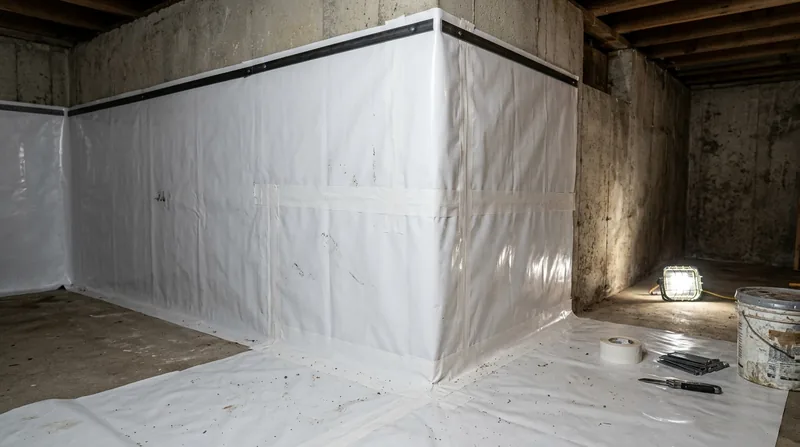




If you own a home in Lynchburg, you know the ground here holds water. The Piedmont red clay that covers most of the city drains slowly, stays saturated for days after a summer thunderstorm, and pushes moisture vapor straight through stone, brick, and early block basement walls. That is why Vapor Barrier Installation in Lynchburg matters: it is the layer that stops ground moisture from turning your lower level into a damp, musty space. In the 1900s-1930s houses around Fort Hill and Diamond Hill, and in the 1940s-1960s ranches of Boonsboro and Tyreeanna, we routinely find bare masonry walls wicking water and no barrier at all. We install heavy-duty vapor barrier sheets across basement walls and slab, seal the seams, tape the terminations, and tie the system into the sump where needed. If you want the full picture of how moisture moves through your foundation, start with our basement waterproofing service.
Why Lynchburg Basements Stay Wet: Clay, Hills, and Old Masonry
Lynchburg sits on steep lots and slow-draining clay, and that combination is hard on basements. The James River bottoms and the creeks that drain the hills rise fast after tropical remnants, and freeze-thaw winters open cracks in older block walls. Water vapor moves through those walls year-round, even when no liquid water is visible.
- Piedmont red clay over granite and schist holds water against the footing and keeps the soil saturated for days.
- Older stone and brick walls in Fort Hill and Rivermont were never built with a modern moisture barrier.
- Poured concrete basements in Forest and Timberlake subdivisions still wick vapor through slab and wall.
- Humid Blue Ridge summers keep the basement air close to saturation, so any vapor source condenses on cool surfaces.
A vapor barrier addresses that vapor source directly, and it works best when paired with drainage that moves liquid water away.
Key info: A 1920s brick house on a Diamond Hill side street showed efflorescence halfway up the wall and a musty smell all summer. The footing drain was slow, and the bare wall was wicking ground vapor. Sealing alone would not have fixed it; a vapor barrier plus drainage did.
For the official word on permits and property maintenance rules in the city, check the City of Lynchburg government site before you schedule structural or drainage work.
How We Install a Vapor Barrier in a Lynchburg Basement
We start by finding out where the moisture is coming from, because a vapor barrier is the wrong answer when the real problem is active hydrostatic pressure. In a Boonsboro split-level with a partly finished basement, we may find a failed drain tile and standing water along the footing. In that case we fix the drainage first, then install the barrier. Every job follows the same field sequence.
- We inspect the walls, slab, and footing and check for efflorescence, cracks, and signs of past water lines.
- We correct active leaks first, using epoxy or polyurethane injection on cracks and repairing the drain tile where it has collapsed.
- We clean and prepare the masonry so the barrier sits flat and the terminations bond.
- We install heavy-duty vapor barrier sheets down the walls and across the slab, overlapping and sealing every seam.
- We tape and mechanically fasten the top and bottom terminations and integrate the barrier with the sump basin and interior perimeter drain.
- We test the sump pump and check valve and confirm the discharge line carries water away from the foundation.
Once the barrier is sealed, the basement stays drier because the vapor source is cut off, not just covered.
Key info: In a 1950s brick ranch in Tyreeanna, we found a bare block wall with visible seepage after every storm. We repaired two hairline cracks with epoxy injection, installed an interior drain tile system tied to a new sump basin, then ran the vapor barrier down the wall and across the slab. The homeowner reported no musty smell the following spring.
If your basement already has an interior drain system, we integrate the new barrier with it; if not, our interior drain tile system is the right foundation for a dry lower level.
Vapor Barrier Approaches We Use in Lynchburg Homes
Not every basement needs the same barrier. The right approach depends on wall material, how finished the space is, and whether liquid water is still entering. The table below shows the options we install most often in the Lynchburg area.
| Approach | Description | Best for |
|---|---|---|
| Wall and slab barrier | Heavy-duty sheet run down the wall and across the floor, seams sealed and terminations taped. | Unfinished basements with damp masonry and no active leaks. |
| Barrier with dimple board | Dimple board holds the barrier off the wall so any seepage drains to the footing. | Older stone and block walls in Fort Hill and Diamond Hill. |
| Barrier tied to interior drain | Barrier integrates with the interior perimeter drain and sump basin. | Basements with hydrostatic pressure and water after storms. |
| Barrier behind finish materials | Barrier installed before framing and drywall go back on a partly finished basement. | Boonsboro and Peakland basements being refinished. |
We match the approach to the wall and the water, so the barrier does its job without trapping moisture behind it.
Vapor Barrier Installation Cost in Lynchburg: What to Expect
Most Lynchburg vapor barrier work starts at $3 per square foot of treated wall and floor area, and the final number depends on the condition of the basement. A bare, dry wall in a Forest subdivision is a simpler job than a 1930s Rivermont basement with bowed block, failed parging, and an old drain tile that needs repair. Access matters too: a steep lot with a narrow exterior stair slows material handling.
We give you a written scope that separates the barrier from any crack injection or drainage repair, so you can see what each part costs. Get two or three estimates and compare scope, not just the bottom line. Our pricing overview explains how we build a number.
Hiring a Waterproofing Contractor Near Lynchburg: What to Check
A vapor barrier is only as good as the prep and sealing behind it, so the contractor matters as much as the material. Ask for proof of licensing and insurance, and confirm the policy covers basement and foundation work. Get at least two written estimates and ask each contractor to explain what they found and why they recommend a specific approach.
- Verify the license and insurance certificate before work starts, and keep a copy for your records.
- Ask for references from Lynchburg-area homeowners with basements similar to yours.
- Confirm who pulls any permit the local building department requires for drainage or structural work.
- Get the warranty terms in writing, including whether it is transferable.
A contractor who walks the basement, explains the moisture source, and puts the scope in writing is the one to hire. Reach out through our contact page to schedule a free basement inspection.
Vapor Barrier Installation Near Me: What Lynchburg Homeowners Should Know
When you search for vapor barrier installation near me in Lynchburg, you will find general foundation firms, plumbers, and dedicated waterproofing specialists. The difference shows up in the diagnosis. A plumber fixes the sump pump; a general foundation firm may jump to exterior excavation. We look at the whole basement and tell you plainly when simple crack sealing is enough and when hydrostatic pressure means you need drainage before a barrier.
We serve homeowners across the city and the surrounding counties, from the older neighborhoods near downtown to the newer subdivisions in Forest and Timberlake. If your basement smells musty or shows efflorescence, the vapor source is worth finding before you finish the space. Call (434) 266-6497 and we will set up a free inspection.
Vapor Barrier Installation in Lynchburg: Pricing Guide
| Service | Price | Details |
|---|---|---|
| Wall and slab vapor barrier | Starting at $3/sq ft | Includes surface prep, heavy-duty sheet, sealed seams, and taped terminations on dry masonry. |
| Barrier with dimple board | Starting at $4.50/sq ft | Adds dimple board drainage mat behind the barrier for older stone and block walls. |
| Barrier tied to interior drain | On estimate | Requires an on-site look to price the drain tile, sump basin, and discharge line together. |
| Crack injection before barrier | Starting at $450 per crack | Epoxy or polyurethane injection on active cracks, priced per crack and depth. |
| Travel | Included | In Lynchburg and surrounding areas, no separate call-out or mileage fee. |
| Estimate | Free | Response within 24h at (434) 266-6497, no obligation to book. |
Indicative pricing, the exact cost depends on square footage, finish, and site access. Free personalized estimate within 24h at (434) 266-6497.


