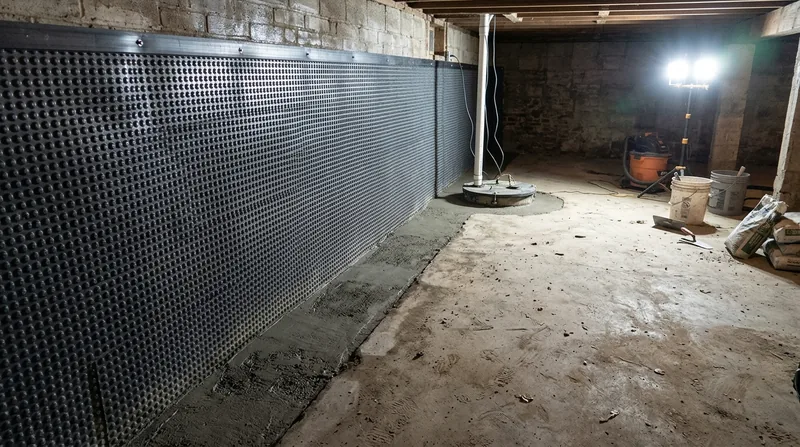




If you own a house in Lynchburg, you already know the ground here. The red Piedmont clay sits over granite and schist, drains slowly, and stays saturated for days after a summer storm. In Fort Hill and Diamond Hill, 1900s brick and frame houses sit on steep lots with stone or early block basement walls. Out in Forest and Timberlake, 1980s to 2010s subdivisions have poured concrete full basements and walkouts cut into the hills. Basement Waterproofing in Lynchburg starts with one question: where is the water actually coming from? We trace the real path, whether it is storm water pushing through the clay, hydrostatic pressure at the footing, or seepage at the floor joint, and then we build the system that fits the house. No guesswork, no one-size-fits-all membrane. Call (434) 266-6497 and we will walk the basement with you. Start with a free basement inspection so we can see what the walls and floor are doing.
Why Lynchburg Basements Take On Water (and Why It Is Not the Same Problem Everywhere)
The failure mode that dominates here is slow drainage in heavy clay. After a tropical remnant or a hard July thunderstorm, the water table rises fast, the clay cannot release it, and hydrostatic pressure finds the weakest point: a cold joint, a hairline crack in a block wall, or the seam where the slab meets the footing. Freeze-thaw winters in the Blue Ridge open those cracks wider in older block and brick walls. In Boonsboro and Peakland, 1940s to 1960s brick ranches and split-levels often have partly finished basements where the first sign is efflorescence or a musty smell, not standing water.
- Water seeps through the floor joint and along the footing because the original weeping tile is clogged or was never installed.
- Block walls in Fort Hill and Diamond Hill wick moisture and show efflorescence as salts push through the masonry.
- Downspouts dump roof water within a few feet of the foundation, and grading slopes back toward the house on steep lots.
- Window wells in Forest walkouts fill during storms and send water straight to the basement wall.
- Sump pumps that run hard in spring fail without a battery backup, and the basin overflows.
Every one of those has a different fix, and sealing the wall alone will not stop water that is being pushed from below.
Key info: In Madison Heights and Rustburg, we routinely find 1950s block basements where a single epoxy injection on a visible crack solves the problem. In Timberlake, the same symptom usually means the footing drain is dead and the water needs an interior perimeter drain, not another coat of sealer. The house tells you which one it is.
Building departments in the Lynchburg area handle foundation and drainage permits at the local level, and the Virginia Department of Health and your city or county building office are the right places to confirm what your project requires before work starts.
How We Waterproof a Lynchburg Basement: Trace, Drain, Seal, Discharge
We do not sell a package before we know the water path. On the first visit we check the block or poured walls for crack patterns, probe the floor joint, look at the grading and downspouts, and ask what the basement does during a James River bottom flood versus a normal rain. Then we lay out the work in order, because a drain without a discharge point is just a wet trench.
- We map the water entry points and confirm whether the problem is hydrostatic pressure, surface water, or both.
- We cut and install an interior perimeter drain at the footing, pitched to a sump basin at the low corner.
- We set the sump pump with a check valve and a discharge line that carries water well away from the foundation.
- We seal wall cracks by epoxy or polyurethane injection, depending on whether the crack is structural or active.
- We treat the walls with a waterproof membrane or dimple board and hang a vapor barrier where moisture control calls for it.
- We correct grading and downspout extensions so roof water stops feeding the clay around the footing.
On a recent job off Rivermont Avenue, a 1920s brick house had water crossing the floor after every hard rain. The original footing drain was collapsed, so we installed an interior drain tile system and a new sump basin, then extended two downspouts to the alley. The floor has stayed dry through two tropical remnants since.
Key info: In a 1960s split-level in Boonsboro, the water was coming through the floor joint, not the wall. Exterior excavation would have cost far more and fixed nothing. The interior drain and a properly sized sump pump solved it in two days.
Waterproofing Methods We Use and When Each One Fits
There is no single method that fits every Lynchburg basement. The table below shows the approaches we use most and the conditions that call for each. We will tell you plainly when simple crack sealing is enough and when the real problem is hydrostatic pressure that needs drainage.
| Approach | Description | Best for |
|---|---|---|
| Interior drain tile system | Perimeter drain cut at the footing, pitched to a sump basin, with wall treatment and vapor barrier. | Hydrostatic pressure and water at the floor joint, common in Forest and Timberlake poured basements. |
| Exterior waterproofing | Excavate to the footing, apply membrane and dimple board, replace the footing drain. | Bowing or deteriorated walls where the exterior must be exposed anyway. |
| Crack injection (epoxy or polyurethane) | Injection ports drilled along the crack, sealed with epoxy for structural cracks or polyurethane for active leaks. | Isolated cracks in block or poured walls, such as in Fort Hill and Diamond Hill. |
| Wall sealing and vapor barrier | Waterproof membrane, parging repairs, and a vapor barrier to control moisture movement. | Damp walls, efflorescence, and musty smells in partly finished basements. |
| Sump pump and battery backup | Sump basin, primary pump, check valve, discharge line, and battery backup for storm outages. | Any drained system that needs reliable discharge during spring storms. |
Basement Waterproofing Cost in Lynchburg: What to Expect
Most Lynchburg homeowners want a number before they want a lecture, so here is the honest range. A focused repair such as crack injection or a small sealing job can start around $2,500. A full interior drain tile system with a sump pump, wall treatment, and vapor barrier runs higher, and the price moves with the linear footage, the number of corners, whether the floor is slab or stone, and how hard it is to get equipment to the wall. Exterior excavation adds cost because it means digging to the footing and restoring the grade.
We do not quote from a photo. The same square footage in a Forest walkout and a Fort Hill stone basement can differ by thousands because the wall construction and access are different. Get two or three estimates and compare scope, not just the total: ask whether the price includes the sump pump, the discharge line, the vapor barrier, and disposal of the spoil. You can see how we break down line items on our pricing page.
Choosing a Basement Waterproofing Contractor Near Lynchburg
Waterproofing is one of those trades where the wrong contractor can leave you with a dry-looking wall and a wet floor next spring. Use the same checklist you would for any foundation work, and do not skip the paperwork.
- Confirm the company is licensed and insured for foundation and drainage work in Virginia, and ask for a certificate of insurance.
- Get at least two or three written estimates that list materials, linear footage, and what is excluded.
- Ask for local references from jobs in Lynchburg, Forest, or Madison Heights and call them.
- Ask who pulls the permit if the work alters drainage or the sump discharge connection, and verify the rule with your local building department.
- Get the warranty in writing and confirm whether it is transferable if you sell the house.
If a contractor will not put the scope and warranty in writing, keep looking. You can reach us through the contact page to set up a free inspection and get a written scope.
Basement Waterproofing Near Me: What Lynchburg Homeowners Should Know
When you search for basement waterproofing near me, you will get a mix of general foundation repair firms, plumbers, and dedicated waterproofing specialists. The difference matters. A plumber can clear a clogged discharge line, and a general foundation firm can pour footings, but a waterproofing specialist reads the water path and builds the drain, sump, and wall system as one piece. In older Lynchburg neighborhoods, that usually means working around stone rubble walls and low headroom, which is a different skill than waterproofing a new poured basement in Forest.
Ask any contractor you call what they would do for a 1930s brick house on a steep lot in Diamond Hill versus a 2005 walkout in Timberlake. If the answer is the same package for both, that is your answer about the contractor. We also serve the surrounding towns, including Madison Heights and Forest, and the terrain changes the diagnosis from one zip code to the next.
One more local note: in the James River bottoms and along the creeks that drain the hills, water rises fast after tropical remnants. A sump pump without a battery backup is a single point of failure, and we see more flooded basements from power outages than from undersized pumps. If your pump is older than about ten years or runs constantly in spring, plan to replace it before the next storm season rather than after.
Basement Waterproofing in Lynchburg: Pricing Guide
| Service | Price | Details |
|---|---|---|
| Crack injection and spot sealing | Starting at $2,500 | Includes epoxy or polyurethane injection on accessible cracks, plus surface sealing; price rises with crack length and wall access. |
| Interior drain tile system | Starting at $4,500 | Perimeter drain at the footing, sump basin, and wall treatment; cost moves with linear footage and number of corners. |
| Full system with sump and vapor barrier | Starting at $7,500 | Drain tile, primary sump pump, check valve, discharge line, and vapor barrier; access and floor type affect the total. |
| Exterior excavation and membrane | On estimate | Requires digging to the footing and restoring grade, so we need an on-site look before quoting. |
| Travel | Included | In Lynchburg and surrounding areas, no separate call-out or mileage fee. |
| Estimate | Free | Response within 24h at (434) 266-6497, no obligation to book. |
Indicative pricing, the exact cost depends on square footage, finish, and site access. Free personalized estimate within 24h at (434) 266-6497.


