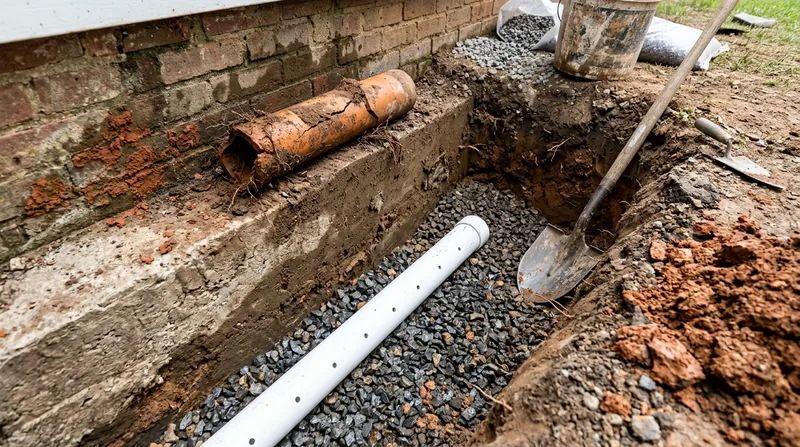




Lynchburg sits on a band of Piedmont red clay over granite and schist, and that clay holds water long after a summer storm has passed. In Fort Hill and Diamond Hill, the 1900s brick and frame houses often still drain through original clay tile footing drains that have been crushed, root-bound, or silted shut for decades. Out in Forest and Timberlake, poured concrete basements on the hills can still take on water when the water table climbs and the old drain line cannot move it away. Drain Tile Repair & Replacement in Lynchburg is the work of finding that failed line, confirming where it broke, and putting a drain back in service that actually carries water to the sump basin or the daylight outlet. We handle the camera inspection, the targeted excavation, and the PVC replacement. If your basement takes water after every hard rain, start with a free basement inspection so we can see the failure before we quote the repair.
Why Failed Drain Tile Is the Real Story Behind Wet Basements in Lynchburg
Most wet basements we open up in Lynchburg are not a wall problem first. They are a drainage problem. The footing drain was supposed to intercept groundwater at the base of the wall and carry it away, and when that line collapses or clogs, hydrostatic pressure builds against the footing and water finds the weakest seam. In the older neighborhoods the original clay tile has often separated at the joints, and tree roots from the mature oaks and maples along the Rivermont streets move straight into the gaps.
- Clay tile lines crack at the joints and let soil fines wash in until the pipe is effectively solid.
- Tree roots enter through hairline gaps and expand until flow drops to a trickle.
- Original tile was often laid with little or no gravel envelope, so it silts up faster.
- Downspouts and grading that push water back toward the foundation overload a drain that is already marginal.
When we camera a line and find it is still open and only partly restricted, we say so, because a full replacement may not be the honest answer.
Key info: A 1920s house on a steep lot in Diamond Hill may have a footing drain that daylights at the curb, while a 1990s build in Forest typically ties into a sump basin. The repair approach follows the outlet, not a standard package. Permits for work that alters drainage or the sanitary connection of a sump discharge vary by jurisdiction, so we confirm the requirement with the City of Lynchburg building department before we dig. You can review the city's permit resources at lynchburgva.gov.
How We Diagnose and Replace a Failed Footing Drain in Lynchburg
We do not quote a drain replacement from the driveway. The first step is always a camera inspection from a cleanout or a hand-dug access point, and the footage tells us whether the line is root-bound, collapsed, or simply silted. From there we map the run, locate the outlet, and decide between a targeted spot repair and a full perimeter replacement. On a Boonsboro ranch with a partly finished basement, that decision usually comes down to how much of the original tile is still sound.
- We camera the existing line and mark every break, root intrusion, and low spot on a sketch of the foundation.
- We confirm the outlet, whether it is a sump basin, a gravity daylight discharge, or a connection we need to verify with the building department.
- We excavate only the failed section when a spot repair will restore flow, and we replace with rigid PVC and a proper gravel envelope.
- We reconnect to the sump basin or discharge line, test flow with water, and backfill in lifts.
- We restore grading and downspout extensions so surface water stops loading the new drain.
Every replacement ends with a flow test, because a drain we cannot see running is not a drain we will call finished.
Key info: On a 1950s split-level in Tyreeanna, we found the original tile had separated under a mature oak and the sump basin was receiving almost nothing. A targeted 18-foot replacement in PVC restored flow without tearing up the whole perimeter. In a 1930s Rivermont house with stone foundation walls, the run daylights downhill and needed a full re-line because the clay tile had collapsed in three places.
If the inspection shows the drain is sound but the wall is still seeping, the better answer may be an interior drain tile system that intercepts water at the wall base rather than relying on the original footing drain.
Repair Options We Use for Drain Tile in Lynchburg
The right approach depends on the pipe material, the depth of the footing, and how much of the run has failed. We do not sell a full replacement when a spot repair will restore the line, and we do not spot-repair a line that is collapsed in five places.
| Approach | Description | Best for |
|---|---|---|
| Targeted spot repair | Excavate and replace one failed section with PVC and reconnect to sound tile. | A single root intrusion or break in an otherwise open line. |
| Full perimeter replacement | Remove failed clay tile and install new rigid PVC with gravel envelope around the footing. | Collapsed or silted lines with multiple failures, common in pre-1950 homes. |
| Interior perimeter drain | Cut a channel at the wall base and lead water to a sump basin instead of relying on the footing drain. | Stone or brick walls where exterior excavation is impractical or the footing drain cannot be restored. |
| Sump basin and pump upgrade | Replace an undersized basin or failed pump so the repaired drain has somewhere to discharge. | Drain is sound but the pump or basin cannot keep up during a storm. |
| Downspout and grading correction | Extend downspouts and regrade so surface water stops loading the drain. | Any repair, because a drain that carries roof water will fail again. |
Drain Tile Repair & Replacement Cost in Lynchburg: What to Expect
Most drain tile repairs in Lynchburg start at $750 for a targeted spot repair with camera inspection included. A full perimeter replacement on a 1930s stone foundation in Fort Hill or a 1960s ranch in Boonsboro runs considerably higher because of excavation length, depth, and the cost of hauling out failed clay tile. The price moves with access, how deep the footing sits, whether the outlet is a gravity daylight or a sump basin, and whether roots have entered the line from a mature tree close to the foundation.
We give a range after the camera inspection, not before, because a drain that looks failed from the basement floor can sometimes be restored with a spot repair. Get two or three estimates and compare what is actually included: camera inspection, excavation, PVC material, gravel, backfill, and flow test. A low number that skips the camera or the flow test is not a comparable bid. Our full pricing overview lays out how we build a number.
Drain Tile Repair & Replacement Near Me: How to Choose a Contractor Near Lynchburg
Ask for the license and insurance certificate before anyone puts a shovel in the ground, and confirm the coverage is current for the company doing the work, not a subcontractor you have never met. Ask whether the estimate includes a camera inspection and a flow test, because those two steps separate a diagnostic repair from a guess. Ask for references from jobs in Lynchburg or the surrounding counties, and call one.
Permits for work that alters drainage or the sanitary connection of a sump discharge vary by jurisdiction, so confirm with the City of Lynchburg building department or the county where the house sits. If the property is in a subdivision with an HOA, check the rules on excavation and equipment access before the crew arrives. We are glad to walk through the scope and the paperwork with you, and you can contact us for a free estimate when you are ready. We also serve outlying areas such as Forest, Madison Heights, and Rustburg, and the same inspection standard applies there.
Drain Tile Repair & Replacement in Lynchburg: Pricing Guide
| Service | Price | Details |
|---|---|---|
| Targeted spot repair | Starting at $750 | Camera inspection, excavation of one failed section, PVC replacement, and flow test included. |
| Full perimeter replacement | Starting at $3,200 | Depends on run length, footing depth, and how much failed clay tile must be hauled out. |
| Interior perimeter drain with sump tie-in | Starting at $4,500 | Chosen when the footing drain cannot be restored or exterior excavation is impractical. |
| Sump basin and pump upgrade | Starting at $1,100 | New basin or pump so a repaired drain has adequate discharge capacity during storms. |
| Complex or large-scale job | On estimate | Deep footings, tight access, stone walls, or multiple failures need an on-site look first. |
| Estimate | Free | Response within 24h at (434) 266-6497, no obligation to book. |
Indicative pricing, the exact cost depends on square footage, finish, and site access. Free personalized estimate within 24h at (434) 266-6497.


