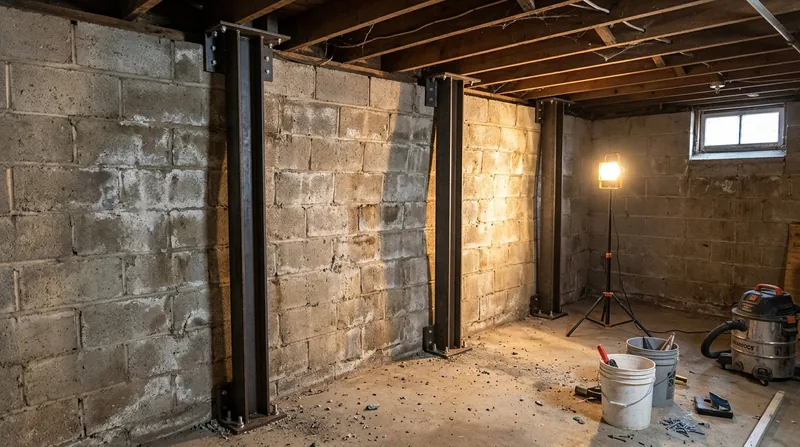




Lynchburg sits on the Piedmont where red clay meets granite and schist, and that geology decides how a foundation wall behaves. In Fort Hill and Diamond Hill, 1900s brick houses sit on steep lots with stone or early block basement walls that lean as the wet clay pushes from behind. Across Boonsboro and Peakland, 1940s-1960s brick ranches show the same problem on partly finished basements. When you need Bowing Wall Repair in Lynchburg, the fix is not cosmetic. We match carbon fiber straps, steel I-beams, or wall anchors to the severity of the movement and the pressure of saturated clay behind the wall. If your wall is still straight but leaking, start with foundation crack repair before structural work is on the table.
Why Bowing Walls Show Up So Often in Lynchburg Hillside Basements
The failure mode here is hydrostatic pressure, not settling. Piedmont red clay drains slowly and stays saturated for days after a summer thunderstorm or the remnants of a tropical system. That water loads the back of older block and brick walls, and the freeze-thaw winters open the mortar joints further. On the hills in Fort Hill, Diamond Hill, and the Rivermont streets, the wall takes that load on one side only, so it bows inward.
- Horizontal cracks in the mortar joints signal pressure, while vertical cracks usually mean shrinkage or settling.
- Brick and early block walls in pre-1940 houses move more than poured concrete because the joints are the weak point.
- Efflorescence, the white salt bloom on the wall face, tells you water is moving through the block.
- Doors and windows that stick on the upper floor mean the wall is rotating, not just cracking.
We measure the inward movement with a plumb line and a level, then decide whether straps alone hold it or the wall needs anchors tied back into stable soil.
Key info: A block wall in a 1920s Rivermont house that has bowed half an inch over ten years is a different job from a wall that moved an inch in one wet spring. The first may hold with carbon fiber straps. The second usually needs wall anchors driven into the clay behind the wall.
Structural foundation repair in Virginia generally requires a permit, and the rules vary by jurisdiction. Always confirm the current requirement with the City of Lynchburg building department before work starts.
How We Stabilize a Bowing Wall on a Lynchburg Lot
We start by finding out why the wall moved, because a strap on a wall that is still taking water is a temporary answer. The inspection covers the wall face, the footing, the grading outside, and where the downspouts discharge. Then we pick the method that matches the movement and the soil load.
- We map the crack pattern and measure the inward deflection at the worst point.
- We check the exterior grade and downspout extensions, since water dumped at the wall keeps the clay saturated.
- We recommend carbon fiber straps for hairline to moderate movement, steel I-beams for walls that need a hard stop, or wall anchors when the wall must be pulled back.
- We install the system and torque it to the manufacturer's spec, then re-check the plumb line.
- We hand you the documentation and explain what to watch over the next wet season.
If the wall is sound but the basement still takes water, the better answer is often an interior drain tile system that relieves the pressure at the footing instead of fighting it at the wall face.
Key info: On a 1950s split-level in Tyreeanna, we found a block wall bowed three-quarters of an inch with a horizontal crack two courses up. Carbon fiber straps every four feet plus a downspout extension to move roof water away from the wall held it without excavation.
Bowing Wall Repair Methods We Use
| Approach | Description | Best for |
|---|---|---|
| Carbon fiber straps | Epoxy-bonded straps from floor to ceiling that resist further inward movement. | Hairline to moderate bowing on block or poured walls. |
| Steel I-beams | Vertical steel beams anchored into the floor and the joist above. | Walls with heavy movement that need a hard stop. |
| Wall anchors | Steel plates on the inside tied to anchors driven into stable soil outside. | Walls that need to be pulled back toward plumb. |
| Epoxy or polyurethane injection | Injection ports fill active cracks and stop water at the crack itself. | Crack sealing once the wall is stable, not a structural fix. |
| Exterior waterproofing with drainage | Membrane and footing drain that relieve the clay load at the source. | Walls that keep moving because the clay stays saturated. |
We pick the lightest method that actually holds the wall, because a strap on a wall that needs anchors wastes your money.
Bowing Wall Repair Cost in Lynchburg: What to Expect
Pricing for bowing wall repair starts at $600 for a straightforward crack injection once the wall is stable, and climbs from there with the method and the length of wall involved. Carbon fiber straps, steel beams, and wall anchors each carry their own material and labor cost, and a hillside lot in Forest or Timberlake with tight access adds time. Two or three estimates is the smart move, and we put our numbers in writing.
What moves the number: the number of straps or beams, whether the wall needs pulling back, how much exterior work the drainage requires, and whether the wall is block, brick, or poured concrete. See the full pricing overview for the line-item detail.
Hiring a Bowing Wall Repair Contractor Near Lynchburg: What to Check
Ask for the license and insurance certificate before anyone touches the wall, and confirm the policy covers structural work. Call two references from jobs at least a year old, and ask whether the wall stayed put through a wet spring. Get the permit question answered by the local building department, not by the contractor alone. And get the scope in writing, including the method and the number of straps or anchors.
Reach us through the contact page to set up an inspection.
Bowing Wall Repair in Lynchburg: Pricing Guide
| Service | Price | Details |
|---|---|---|
| Crack injection (epoxy or polyurethane) | Starting at $600 | Covers active crack sealing once the wall is stable, priced by crack length and access |
| Carbon fiber strap installation | Starting at $850 per strap | Epoxy-bonded strap from floor to ceiling, priced by wall length and number of straps |
| Steel I-beam or wall anchor system | On estimate | Needs an on-site look at movement, soil load, and whether the wall must be pulled back |
| Exterior drainage correction | On estimate | Membrane and footing drain work priced after we see the grade and clay saturation |
| Travel | Included | in Lynchburg and surrounding areas, no separate call-out or mileage fee |
| Estimate | Free | Response within 24h at (434) 266-6497, no obligation to book |
Indicative pricing, the exact cost depends on square footage, finish, and site access. Free personalized estimate within 24h at (434) 266-6497.


