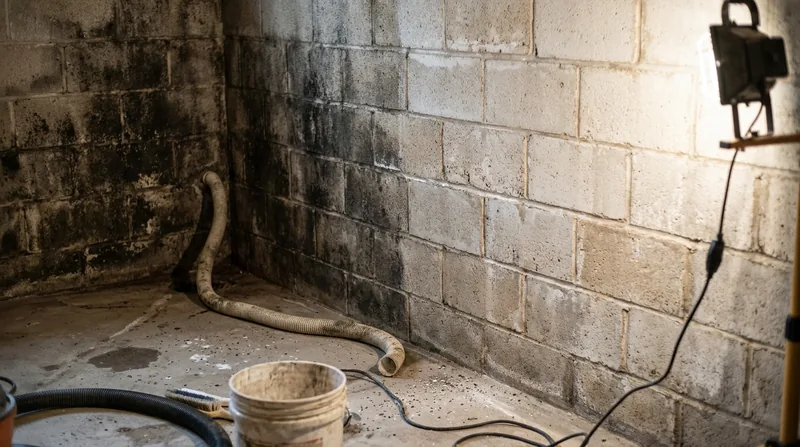




If you live in Fort Hill, Diamond Hill, or along the Rivermont streets, you already know how Piedmont red clay behaves after a summer thunderstorm. That slow-draining clay sits over granite and schist, stays saturated for days, and pushes water through stone, brick, and early block walls in 1900s-1930s basements. When that moisture never dries out, Basement Mold Remediation in Lynchburg becomes the only real fix, because wiping down the walls without stopping the water source just brings the mold back. We pair containment and treatment of affected surfaces with the drainage, sealing, or dehumidification work that keeps the basement dry. If you have a musty smell that will not quit, we diagnose the moisture path first. Start with a free basement inspection and we will tell you plainly what is feeding the problem.
Why Basement Mold Keeps Coming Back in Lynchburg's Older Basements
Lynchburg sits on slow-draining clay over bedrock, so water seeps along the footing and wicks into masonry instead of disappearing. In the older brick and frame houses of Fort Hill and Diamond Hill, that means stone and brick walls stay damp for weeks after a storm. In the 1940s-1960s ranches and split-levels of Boonsboro and Tyreeanna, partly finished basements trap humid air behind paneling and carpet. Mold is a moisture problem, and the building materials tell you where the moisture is coming from.
- Efflorescence and white chalky staining on block walls point to water moving through the masonry.
- A musty smell that gets stronger after rain usually means the footing drain or interior perimeter drain is not moving water away.
- Peeling paint, soft drywall, and dark staining at the base of walls show where moisture has been sitting.
- High humidity in a finished basement often traces back to a missing or failing vapor barrier and no dehumidification.
We treat the mold and fix the moisture path, because remediation without drainage just resets the clock.
Key info: A 1920s brick basement on a steep Rivermont lot can look dry in July and grow mold by September, because the clay above the footing holds water from summer storms and releases it slowly into the wall.
For official guidance on moisture and mold in homes, the EPA mold resources are a solid reference, and our job is to apply that guidance to Lynchburg's building stock.
How We Run Basement Mold Remediation in Lynchburg
We start by finding the water, not by spraying the mold. A moisture meter and a visual walk of the basement tell us whether the source is hydrostatic pressure at the wall base, a failed sump pump, a clogged drain tile, or humid air with nowhere to go. From there we set containment, treat the affected surfaces, and fix the moisture path so the growth does not return. The sequence matters: remediation first, then the drainage or sealing work that keeps the basement dry.
- We inspect the basement, the wall base, and the sump basin to locate the moisture source.
- We set up containment and negative air so spores do not spread into the living space above.
- We remove or treat affected materials and clean the surfaces with a mold-specific product.
- We correct the moisture path with drainage, sealing, or dehumidification sized to the basement.
- We verify dryness with a meter before we close the job and walk you through what we found.
Every job ends with a clear explanation of what caused the moisture and what we did about it.
Key info: In a 1980s Forest subdivision with a poured concrete walkout, we often find mold on the lower wall of the uphill side only, which points to exterior grading and a downspout that dumps water against the foundation. The fix is drainage, not another coat of paint.
When the moisture source is a wall crack rather than a drainage failure, we pair remediation with foundation crack repair so the wall stops taking on water.
Remediation and Moisture-Control Approaches We Use
Not every mold problem needs the same fix. A small patch above a hairline crack is a different job from a finished basement with wet carpet and a failed sump pump. The table below shows the approaches we use most in Lynchburg and the situations each one fits.
| Approach | Description | Best for |
|---|---|---|
| Containment and surface treatment | Sealed work area, HEPA filtration, treatment of affected framing and masonry. | Localized growth on walls, joists, or stored items. |
| Drainage correction | Interior perimeter drain or drain tile repair to move water to the sump basin. | Recurring damp walls and musty smell after storms. |
| Wall sealing and vapor control | Basement wall sealing and a vapor barrier to cut humid air and wicking. | Efflorescence and damp masonry in older basements. |
| Dehumidification | Sized dehumidifier and ventilation plan for finished or partly finished space. | High humidity without an active water leak. |
| Sump and discharge repair | Sump pump replacement, check valve, and discharge line routing away from the wall. | Water on the floor after a pump failure or power loss. |
We choose the lightest approach that actually solves the moisture problem, and we tell you when simple sealing is enough.
Basement Mold Remediation Cost in Lynchburg: What to Expect
Most basement mold remediation jobs in Lynchburg start around From $1,500, and that figure usually covers containment, treatment of affected surfaces, and a moisture diagnosis. The number moves up with the size of the affected area, whether finished materials like drywall and carpet have to come out, and whether the moisture fix itself is a small sealing job or a full interior drain tile system. A single damp wall in a Boonsboro ranch is a different scope from a finished walkout in Forest with wet framing.
We quote remediation and the moisture correction as separate line items so you can see what each part costs. That matters because the drainage work is what keeps the mold from returning, and you should know what you are buying. Getting two or three estimates is smart in this trade, and any honest contractor will walk the basement with you and explain the moisture source before quoting. Our full pricing overview lays out how the numbers come together.
Key info: A Madison Heights homeowner with mold on two block walls paid less than a Forest homeowner with a finished basement because the finished job needed material removal, containment over carpet, and a larger dehumidifier. Same symptom, different scope.
Basement Mold Remediation Near Me: How to Choose a Contractor Near Lynchburg
When you search for basement mold remediation near me, the first thing to check is whether the company is licensed and insured for the work it is quoting. Ask for the certificate, not just a verbal yes. Then get two or three written estimates and compare what each one includes: containment, material removal, the moisture fix, and disposal. A low number that skips the drainage work is not a lower price, it is a shorter job that comes back.
Ask for local references from basements similar to yours, especially if you own an older brick or stone foundation. If the work involves structural repair or a new sump discharge connection, permits may be required, and the local building department is the authority on thresholds, so confirm before work starts. You can reach us through the contact page to set up a walkthrough.
Basement Mold Remediation in Lynchburg: Pricing Guide
| Service | Price | Details |
|---|---|---|
| Surface remediation and containment | Starting at $1,500 | Includes containment, HEPA filtration, treatment of affected walls and framing, and moisture diagnosis on site. |
| Remediation with drainage correction | Starting at $3,200 | Adds interior perimeter drain or drain tile repair so the moisture source is corrected, not just cleaned. |
| Finished basement remediation | Starting at $4,500 | Covers removal of affected drywall, carpet, or paneling plus containment and dehumidification sized to the space. |
| Complex or large-scale job | On estimate | Full basement with widespread growth and structural moisture needs an on-site look before a number is given. |
| Travel | Included | in Lynchburg and surrounding areas, no separate call-out or mileage fee |
| Estimate | Free | Response within 24h at (434) 266-6497, no obligation to book |
Indicative pricing, the exact cost depends on square footage, finish, and site access. Free personalized estimate within 24h at (434) 266-6497.


